
learn more
Federica Bortoluzzi
Beethoven Schubert Brahams
Kyklos

“The extinguished wood, the burning wood, the embers, the ashes, and the wind that scatters them have taken turns in the luminous circle of appearing.”
Emanuele Severino, La Strada
A cyclical time in which what exists reappears, continuously transformed.
This idea runs through the centuries and can be found in Heraclitus, Parmenides, in the Orphic theory of metempsychosis, as well as in Einstein, Poincaré, and modern philosophies. While changing form, an element preserves its substance: an original core undergoes successive transformations without losing its specific nature. In this way, musical material and philosophical conception intertwine: what returns is never identical, yet retains its essence, like a theme that passes through variations without losing its identity.
The three works presented here express this principle from different perspectives. In Beethoven, in the cycle of variations of the third movement of Sonata op.109, the theme of pure and luminous contemplation undergoes a progressive meditative deepening: through changes in rhythm, density, and texture, the material evolves from the first variation to culminate in the solemn and religious tone of the final fugato, only to reappear in its original, simple, and transparent form, closing the circle as a memory of the journey
undertaken.
In Schubert, in the Impromptu op.142 no.3, the theme unfolds in variations that, starting from a motif dear to the composer (also used in Rosamunde), suggest tender states of the soul, the movements of the Ländler, the composed anxiety for the impending fate, the dawn of a joyful hope, and finally a childlike luminous lightness that, after passing through different expressive states tends to settle, finding gentle comfort in the opening song.
In Brahms, in the Variations and Fugue op.24, Händel’s theme becomes the basis for an extensive structural elaboration conceived with formal intent but immense musical inventiveness: each variation explores different worlds and emotions with vivid imagination. Like a true explorer, Händel’s theme traverses 25 variations, passing through baroque archaisms, elegiac songs, organ- and orchestral-like timbres and resonances, rhythms and dances with folk echoes, until the monumental final fugue, whose subject arises from the first three notes of the theme, closing the journey in a synthesis that returns to the origin. Thus, in this cyclicity, each form contains within itself the essence of the whole: what changes reveals, in filigree, the immutable core that passes through
time and transformation, unveiling the infinite expressions of the same face. Kyklos is not only the thread that connects these pieces, but a self-portrait gathering profound aspects of my journey: in Beethoven, the knowledge and responsibility accompanying the
study of this composer are rooted in my musical origins, and with Sonata op.109 the mystical aspect emerges, projecting my gaze toward the absolute. With Schubert’s Impromptu, a very personal space opens, linked to the inner self, a place of intense emotional connection naturally close to me. In Brahms, finally, the journey finds synthesis in a dialogue between memory, reflection, and artistic maturation, and becomes an affectionate dedication to my pianist mother.
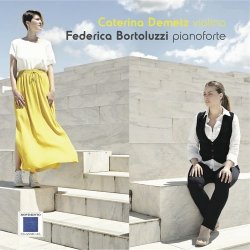

Federica Bortoluzzi
Born in Milan in 1988 in a family of musicians, she began studying the piano under the guidance of Alberto Colombo at the age of six. He perfected the study of the piano with Andrea Lucchesini and Maria Tipo, through whom he learned and shared a research and thought that marked his musical growth.
At the age of 13 she gave a recital for the Season at the Playhouse in Vancouver, Canada, starting her first Masterclass, in collaboration with the Tom Lee Academy, an event that distinguished her by awarding her the merit from the House of Commons of Canada. In his concert career he has given concerts for organizations such as La Società dei Concerti in Milan, La Verdi in Milan, La Società Filarmonica in Rovereto, Fondazione Teatro Grande in Brescia,
abroad in Greece in Lefkada and kythira, in Portugal at the National Theatre of Coimbra, in Austria at the concert hall of the Mozarteum in Salzburg, in Switzerland in the Auditorium of the Lugano Conservatory. In addition to his solo activity, he also dedicates himself to chamber music, a musical expression to which he devotes particular attention in the piano duo with the Pianist Giovanni Nesi, in the duo with the violinist Caterina Demetz, e in diverse altre formazioni. Come musicista è molto apprezzata per la genuinità e chiarezza delle sue interpretazioni anche da musicisti e personalità di chiara fama come A.Ciccolini, C.Katsaris, J.P.Luisada, V.Askenazy, J.Biegel, Bruno Canino.
He participated in numerous competitions, winning in 2014 the second Prize and Special Audience Prize at the prestigious International Piano Competition "Rina Sala Gallo" in Monza; among the various awards we remember the "M. Zana" Award 2011 for the best interpreter of pieces by Franz Liszt, as part of the Competition "National Prize of the Arts 2011 (AFAM) , “Camillo Togni di Brescia”. Ha registrato per “Radio Classica” musiche di F.Chopin per la trasmissione “Il Pianista”.Ha suonato in diretta radiofonica a Rai Radio3 alla trasmissione condatta da Oreste Bossini “La stanza della Musica”, in duo con il pianista Giovanni Nesi. Insegna Pianoforte Principale all'Istituto Superiore di Studi Musicali "P.Mascagni" di Livorno.